Showing posts with label 100% Independent Australian News. Show all posts

Thursday, June 19, 2014

10 PAINFULLY OBVIOUS TRUTHS EVERYONE FORGETS TOO SOON

feature_image_template61-620x400
Photo Source: LiveLearnEvolve By: Marc and Angel
 
You know how you can hear something a hundred times in a hundred different ways before it finally gets through to you?  The ten truths listed below fall firmly into that category – life lessons that many of us likely learned years ago, and have been reminded of ever since, but for whatever reason, haven’t fully grasped.

This, my friends, is my attempt at helping all of us, myself included, “get it” and “remember it” once and for all…

1.  The average human life is relatively short.

We know deep down that life is short, and that death will happen to all of us eventually, and yet we are infinitely surprised when it happens to someone we know.  It’s like walking up a flight of stairs with a distracted mind, and misjudging the final step.  You expected there to be one more stair than there is, and so you find yourself off balance for a moment, before your mind shifts back to the present moment and how the world really is.

LIVE your life TODAY!  Don’t ignore death, but don’t be afraid of it either.  Be afraid of a life you never lived because you were too afraid to take action.  Death is not the greatest loss in life.  The greatest loss is what dies inside you while you’re still alive.  Be bold.  Be courageous.  Be scared to death, and then take the next step anyway.

2.  You will only ever live the life you create for yourself.
 
Your life is yours alone.  Others can try to persuade you, but they can’t decide for you.  They can walk with you, but not in your shoes.  So make sure the path you decide to walk aligns with your own intuition and desires, and don’t be scared to switch paths or pave a new one when it makes sense.

Remember, it’s always better to be at the bottom of the ladder you want to climb than the top of the one you don’t.  Be productive and patient.  And realize that patience is not about waiting, but the ability to keep a good attitude while working hard for what you believe in.  This is your life, and it is made up entirely of your choices.  May your actions speak louder than your words.  May your life preach louder than your lips.  May your success be your noise in the end.

And if life only teaches you one thing, let it be that taking a passionate leap is always worth it.  Even if you have no idea where you’re going to land, be brave enough to step up to the edge of the unknown, and listen to your heart.  (Angel and I discuss this in more detail in the “Passion and Growth” chapter of 1,000 Little Things Happy, Successful People Do Differently.)

3.  Being busy does NOT mean being productive.

Busyness isn’t a virtue, nor is it something to respect.  Though we all have seasons of crazy schedules, very few of us have a legitimate need to be busy ALL the time.  We simply don’t know how to live within our means, prioritize properly, and say no when we should.

Being busy rarely equates to productivity these days.  Just take a quick look around.  Busy people outnumber productive people by a wide margin.  Busy people are rushing all over the place, and running late half of the time.  They’re heading to work, conferences, meetings, social engagements, etc.  They barely have enough free time for family get-togethers and they rarely get enough sleep.
  
Yet, emails are shooting out of their smart phones like machine gun bullets, and their day planners are jammed to the brim with obligations.  Their busy schedule gives them an elevated sense of importance.  But it’s all an illusion.  They’re like hamsters running on a wheel.

Though being busy can make us feel more alive than anything else for a moment, the sensation is not sustainable long term.  We will inevitably, whether tomorrow or on our deathbed, come to wish that we spent less time in the buzz of busyness and more time actually living a purposeful life.

4.  Some kind of failure always occurs before success.

Most mistakes are unavoidable.  Learn to forgive yourself.  It’s not a problem to make them.  It’s only a problem if you never learn from them.

If you’re too afraid of failure, you can’t possibly do what needs to be done to be successful.  The solution to this problem is making friends with failure.  You want to know the difference between a master and a beginner?  The master has failed more times than the beginner has even tried.  Behind every great piece of art is a thousand failed attempts to make it, but these attempts are simply never shown to us.

Bottom line:  Just because it’s not happening now, doesn’t mean it never will.  Sometimes things have to go very wrong before they can be right.  (Read The Success Principles.)

5.  Thinking and doing are two very different things.

Success never comes to look for you while you wait around thinking about it.

You are what you do, not what you say you’ll do.  Knowledge is basically useless without action.  Good things don’t come to those who wait; they come to those who work on meaningful goals.  Ask yourself what’s really important and then have the courage to build your life around your answer.
And remember, if you wait until you feel 100% ready to begin, you’ll likely be waiting the rest of your life.

6.  You don’t have to wait for an apology to forgive.

Life gets much easier when you learn to accept all the apologies you never got.  The key is to be thankful for every experience – positive or negative.  It’s taking a step back and saying, “Thank you for the lesson.”  It’s realizing that grudges from the past are a perfect waste of today’s happiness, and that holding one is like letting unwanted company live rent free in your head.

Forgiveness is a promise – one you want to keep.  When you forgive someone you are making a promise not to hold the unchangeable past against your present self.  It has nothing to do with freeing a criminal of his or her crime, and everything to do with freeing yourself of the burden of being an eternal victim.

7.  Some people are simply the wrong match for you.

You will only ever be as great as the people you surround yourself with, so be brave enough to let go of those who keep bringing you down.  You shouldn’t force connections with people who constantly make you feel less than amazing.

If someone makes you feel uncomfortable and insecure every time you’re with them, for whatever reason, they’re probably not close friend material.  If they make you feel like you can’t be yourself, or if they make you “less than” in any way, don’t pursue a connection with them.  If you feel emotionally drained after hanging out with them or get a small hit of anxiety when you are reminded of them, listen to your intuition.  There are so many “right people” for you, who energize you and inspire you to be your best self.  It makes no sense to force it with people who are the wrong match for you.

8.  It’s not other people’s job to love you; it’s yours.

It’s important to be nice to others, but it’s even more important to be nice to yourself.  You really have to love yourself to get anything done in this world.  So make sure you don’t start seeing yourself through the eyes of those who don’t value you.  Know your worth, even if they don’t.

Today, let someone love you just the way you are – as flawed as you might be, as unattractive as you sometimes feel, and as incomplete as you think you are.  Yes, let someone love you despite all of this, and let that someone be YOU.  (Read Love Yourself Like Your Life Depends On It.)

9.  What you own is not who YOU are.

Stuff really is just stuff, and it has absolutely no bearing on who you are as a person.  Most of us can make do with much less than we think we need.  That’s a valuable reminder, especially in a hugely consumer-driven culture that focuses more on material things than meaningful connections and experiences.

You have to create your own culture.  Don’t watch TV, don’t read every fashion magazine, and don’t consume too much of the evening news.  Find the strength to fill your time with meaningful experiences.  The space and time you are occupying at this very moment is LIFE, and if you’re worrying about Kim Kardashian or Lebron James or some other famous face, then you are disempowered.  You’re giving your life away to marketing and media trickery, which is created by big companies to ultimately motivate you to want to dress a certain way, look a certain way, and be a certain way.  This is tragic, this kind of thinking.  It’s all just Hollywood brainwashing.  What is real is YOU and your friends and your family, your loves, your highs, your hopes, your plans, your fears, etc.

Too often we’re told that we’re not important, we’re just peripheral to what is.  “Get a degree, get a job, get a car, get a house, and keep on getting.”  And it’s sad, because someday you’ll wake up and realize you’ve been tricked.  And all you’ll want then is to reclaim your mind by getting it out of the hands of the brainwashers who want to turn you into a drone that buys everything that isn’t needed to impress everyone that isn’t important.

10.  Everything changes, every second.

Embrace change and realize it happens for a reason.  It won’t always be obvious at first, but in the end it will be worth it.

What you have today may become what you had by tomorrow.  You never know.  Things change, often spontaneously.  People and circumstances come and go.  Life doesn’t stop for anybody.  It moves rapidly and rushes from calm to chaos in a matter of seconds, and happens like this to people every day.  It’s likely happening to someone nearby right now.

Sometimes the shortest split second in time changes the direction of our lives.  A seemingly innocuous decision rattles our whole world like a meteorite striking Earth.  Entire lives have been swiveled and flipped upside down, for better or worse, on the strength of an unpredictable event.  And these events are always happening.

However good or bad a situation is now, it will change.  That’s the one thing you can count on.  So when life is good, enjoy it.  Don’t go looking for something better every second.  Happiness never comes to those who don’t appreciate what they have while they have it.

Your turn…

What else would you add to this list?  What important life lessons do you often forget?  Leave a comment below and share your thoughts.


Wednesday, June 18, 2014

WHAT A SHAMAN SEE’S IN A MENTAL HOSPITAL

June 16, 2014 

The Shamanic View of Mental Illness

In the shamanic view, mental illness signals “the birth of a healer,” explains Malidoma Patrice Somé.  Thus, mental disorders are spiritual emergencies, spiritual crises, and need to be regarded as such to aid the healer in being born.
What those in the West view as mental illness, the Dagara people regard as “good news from the other world.”  The person going through the crisis has been chosen as a medium for a message to the community that needs to be communicated from the spirit realm.  “Mental disorder, behavioral disorder of all kinds, signal the fact that two obviously incompatible energies have merged into the same field,” says Dr. Somé.  These disturbances result when the person does not get assistance in dealing with the presence of the energy from the spirit realm.

One of the things Dr. Somé encountered when he first came to the United States in 1980 for graduate study was how this country deals with mental illness.  When a fellow student was sent to a mental institute due to “nervous depression,” Dr. Somé went to visit him.

“I was so shocked.  That was the first time I was brought face to face with what is done here to people exhibiting the same symptoms I’ve seen in my village.”  What struck Dr. Somé was that the attention given to such symptoms was based on pathology, on the idea that the condition is something that needs to stop.  This was in complete opposition to the way his culture views such a situation.  As he looked around the stark ward at the patients, some in straitjackets, some zoned out on medications, others screaming, he observed to himself, “So this is how the healers who are attempting to be born are treated in this culture.  What a loss!  What a loss that a person who is finally being aligned with a power from the other world is just being wasted.”

Another way to say this, which may make more sense to the Western mind, is that we in the West are not trained in how to deal or even taught to acknowledge the existence of psychic phenomena, the spiritual world.  In fact, psychic abilities are denigrated.  When energies from the spiritual world emerge in a Western psyche, that individual is completely unequipped to integrate them or even recognize what is happening.  The result can be terrifying.  Without the proper context for and assistance in dealing with the breakthrough from another level of reality, for all practical purposes, the person is insane.  Heavy dosing with anti-psychotic drugs compounds the problem and prevents the integration that could lead to soul development and growth in the individual who has received these energies.

On the mental ward, Dr Somé saw a lot of “beings” hanging around the patients, “entities” that are invisible to most people but that shamans and psychics are able to see.  “They were causing the crisis in these people,” he says.  It appeared to him that these beings were trying to get the medications and their effects out of the bodies of the people the beings were trying to merge with, and were increasing the patients’ pain in the process.  “The beings were acting almost like some kind of excavator in the energy field of people.  They were really fierce about that.  The people they were doing that to were just screaming and yelling,” he said.  He couldn’t stay in that environment and had to leave.

In the Dagara tradition, the community helps the person reconcile the energies of both worlds–”the world of the spirit that he or she is merged with, and the village and community.”  That person is able then to serve as a bridge between the worlds and help the living with information and healing they need.  Thus, the spiritual crisis ends with the birth of another healer.  “The other world’s relationship with our world is one of sponsorship,” Dr. Somé explains.  “More often than not, the knowledge and skills that arise from this kind of merger are a knowledge or a skill that is provided directly from the other world.”

The beings who were increasing the pain of the inmates on the mental hospital ward were actually attempting to merge with the inmates in order to get messages through to this world.  The people they had chosen to merge with were getting no assistance in learning how to be a bridge between the worlds and the beings’ attempts to merge were thwarted.  The result was the sustaining of the initial disorder of energy and the aborting of the birth of a healer.

“The Western culture has consistently ignored the birth of the healer,” states Dr. Somé.

“Consequently, there will be a tendency from the other world to keep trying as many people as possible in an attempt to get somebody’s attention.  They have to try harder.”  The spirits are drawn to people whose senses have not been anesthetized.  “The sensitivity is pretty much read as an invitation to come in,” he notes.

Those who develop so-called mental disorders are those who are sensitive, which is viewed in Western culture as oversensitivity.  Indigenous cultures don’t see it that way and, as a result, sensitive people don’t experience themselves as overly sensitive.  In the West, “it is the overload of the culture they’re in that is just wrecking them,” observes Dr. Somé.  The frenetic pace, the bombardment of the senses, and the violent energy that characterize Western culture can overwhelm sensitive people.


Schizophrenia and Foreign Energy

 
With schizophrenia, there is a special “receptivity to a flow of images and information, which cannot be controlled,” stated Dr. Somé.  “When this kind of rush occurs at a time that is not personally chosen, and particularly when it comes with images that are scary and contradictory, the person goes into a frenzy.”

What is required in this situation is first to separate the person’s energy from the extraneous foreign energies, by using shamanic practice (what is known as a “sweep”) to clear the latter out of the individual’s aura.  With the clearing of their energy field, the person no longer picks up a flood of information and so no longer has a reason to be scared and disturbed, explains Dr. Somé.

Then it is possible to help the person align with the energy of the spirit being attempting to come through from the other world and give birth to the healer.  The blockage of that emergence is what creates problems.  “The energy of the healer is a high-voltage energy,” he observes.  “When it is blocked, it just burns up the person.  It’s like a short-circuit.  Fuses are blowing.  This is why it can be really scary, and I understand why this culture prefers to confine these people.  Here they are yelling and screaming, and they’re put into a straitjacket.  That’s a sad image.”  Again, the shamanic approach is to work on aligning the energies so there is no blockage, “fuses” aren’t blowing, and the person can become the healer they are meant to be.

It needs to be noted at this point, however, that not all of the spirit beings that enter a person’s energetic field are there for the purposes of promoting healing.  There are negative energies as well, which are undesirable presences in the aura.  In those cases, the shamanic approach is to remove them from the aura, rather than work to align the discordant energies

Alex:  Crazy in the USA, Healer in Africa

To test his belief that the shamanic view of mental illness holds true in the Western world as well as in indigenous cultures, Dr. Somé took a mental patient back to Africa with him, to his village.  “I was prompted by my own curiosity to find out whether there’s truth in the universality that mental illness could be connected with an alignment with a being from another world,” says Dr. Somé.

Alex was an 18-year-old American who had suffered a psychotic break when he was 14.  He had hallucinations, was suicidal, and went through cycles of dangerously severe depression.  He was in a mental hospital and had been given a lot of drugs, but nothing was helping.  “The parents had done everything–unsuccessfully,” says Dr. Somé.  “They didn’t know what else to do.”

With their permission, Dr. Somé took their son to Africa.  “After eight months there, Alex had become quite normal, Dr. Somé reports.  He was even able to participate with healers in the business of healing; sitting with them all day long and helping them, assisting them in what they were doing with their clients . . . . He spent about four years in my village.”  Alex stayed by choice, not because he needed more healing.  He felt, “much safer in the village than in America.”

To bring his energy and that of the being from the spiritual realm into alignment, Alex went through a shamanic ritual designed for that purpose, although it was slightly different from the one used with the Dagara people.  “He wasn’t born in the village, so something else applied.  But the result was similar, even though the ritual was not literally the same,” explains Dr. Somé.  The fact that aligning the energy worked to heal Alex demonstrated to Dr. Somé that the connection between other beings and mental illness is indeed universal.

After the ritual, Alex began to share the messages that the spirit being had for this world. 

Unfortunately, the people he was talking to didn’t speak English (Dr. Somé was away at that point). 

The whole experience led, however, to Alex’s going to college to study psychology.  He returned to the United States after four years because “he discovered that all the things that he needed to do had been done, and he could then move on with his life.”

The last that Dr. Somé heard was that Alex was in graduate school in psychology at Harvard.  No one had thought he would ever be able to complete undergraduate studies, much less get an advanced degree.

Dr. Somé sums up what Alex’s mental illness was all about:  “He was reaching out.  It was an emergency call.  His job and his purpose was to be a healer.  He said no one was paying attention to that.”

After seeing how well the shamanic approach worked for Alex, Dr. Somé concluded that spirit beings are just as much an issue in the West as in his community in Africa.  “Yet the question still remains, the answer to this problem must be found here, instead of having to go all the way overseas to seek the answer.  There has to be a way in which a little bit of attention beyond the pathology of this whole experience leads to the possibility of coming up with the proper ritual to help people.

Longing for Spiritual Connection

A common thread that Dr. Somé has noticed in “mental” disorders in the West is “a very ancient ancestral energy that has been placed in stasis, that finally is coming out in the person.”  His job then is to trace it back, to go back in time to discover what that spirit is.  In most cases, the spirit is connected to nature, especially with mountains or big rivers, he says.

In the case of mountains, as an example to explain the phenomenon, “it’s a spirit of the mountain that is walking side by side with the person and, as a result, creating a time-space distortion that is affecting the person caught in it.”  What is needed is a merger or alignment of the two energies, “so the person and the mountain spirit become one.”  Again, the shaman conducts a specific ritual to bring about this alignment.

Dr. Somé believes that he encounters this situation so often in the United States because “most of the fabric of this country is made up of the energy of the machine, and the result of that is the disconnection and the severing of the past.  You can run from the past, but you can’t hide from it.”  The ancestral spirit of the natural world comes visiting.  “It’s not so much what the spirit wants as it is what the person wants,” he says.  “The spirit sees in us a call for something grand, something that will make life meaningful, and so the spirit is responding to that.”
That call, which we don’t even know we are making, reflects “a strong longing for a profound connection, a connection that transcends materialism and possession of things and moves into a tangible cosmic dimension.  Most of this longing is unconscious, but for spirits, conscious or unconscious doesn’t make any difference.”  They respond to either.
As part of the ritual to merge the mountain and human energy, those who are receiving the “mountain energy” are sent to a mountain area of their choice, where they pick up a stone that calls to them.  They bring that stone back for the rest of the ritual and then keep it as a companion; some even carry it around with them.  “The presence of the stone does a lot in tuning the perceptive ability of the person,” notes Dr. Somé.  “They receive all kinds of information that they can make use of, so it’s like they get some tangible guidance from the other world as to how to live their life.”
When it is the “river energy,” those being called go to the river and, after speaking to the river spirit, find a water stone to bring back for the same kind of ritual as with the mountain spirit.

“People think something extraordinary must be done in an extraordinary situation like this,” he says.  That’s not usually the case.  Sometimes it is as simple as carrying a stone.

A Sacred Ritual Approach to Mental Illness

One of the gifts a shaman can bring to the Western world is to help people rediscover ritual, which is so sadly lacking.  “The abandonment of ritual can be devastating.  From the spiritual view, ritual is inevitable and necessary if one is to live,” Dr. Somé writes in Ritual:  Power, Healing, and Community. “To say that ritual is needed in the industrialized world is an understatement.  We have seen in my own people that it is probably impossible to live a sane life without it.”

Dr. Somé did not feel that the rituals from his traditional village could simply be transferred to the West, so over his years of shamanic work here, he has designed rituals that meet the very different needs of this culture.  Although the rituals change according to the individual or the group involved, he finds that there is a need for certain rituals in general.

One of these involves helping people discover that their distress is coming from the fact that they are “called by beings from the other world to cooperate with them in doing healing work.”  Ritual allows them to move out of the distress and accept that calling.

Another ritual need relates to initiation.  In indigenous cultures all over the world, young people are initiated into adulthood when they reach a certain age.  The lack of such initiation in the West is part of the crisis that people are in here, says Dr. Somé.  He urges communities to bring together “the creative juices of people who have had this kind of experience, in an attempt to come up with some kind of an alternative ritual that would at least begin to put a dent in this kind of crisis.”
Another ritual that repeatedly speaks to the needs of those coming to him for help entails making a bonfire, and then putting into the bonfire “items that are symbolic of issues carried inside the individuals . . . It might be the issues of anger and frustration against an ancestor who has left a legacy of murder and enslavement or anything, things that the descendant has to live with,” he explains.  “If these are approached as things that are blocking the human imagination, the person’s life purpose, and even the person’s view of life as something that can improve, then it makes sense to begin thinking in terms of how to turn that blockage into a roadway that can lead to something more creative and more fulfilling.”

The example of issues with an ancestors touches on rituals designed by Dr. Somé that address a serious dysfunction in Western society and in the process “trigger enlightenment” in participants.  These are ancestral rituals, and the dysfunction they are aimed at is the mass turning-of-the-back on ancestors.  Some of the spirits trying to come through, as described earlier, may be “ancestors who want to merge with a descendant in an attempt to heal what they weren’t able to do while in their physical body.”

“Unless the relationship between the living and the dead is in balance, chaos ensues,” he says.  “The Dagara believe that, if such an imbalance exists, it is the duty of the living to heal their ancestors.  If these ancestors are not healed, their sick energy will haunt the souls and psyches of those who are responsible for helping them.”  The rituals focus on healing the relationship with our ancestors, both specific issues of an individual ancestor and the larger cultural issues contained in our past.  Dr. Somé has seen extraordinary healing occur at these rituals.

Taking a sacred ritual approach to mental illness rather than regarding the person as a pathological case gives the person affected–and indeed the community at large–the opportunity to begin looking at it from that vantage point too, which leads to “a whole plethora of opportunities and ritual initiative that can be very, very beneficial to everyone present,” states. Dr. Somé.

The Shamanic View of Mental Illness
by Stephanie Marohn (featuring Malidoma Patrice Somé)
(Excerpted from The Natural Medicine Guide to Schizophrenia,
pages 178-189, or The Natural Medicine Guide to Bi-polar Disorder)

http://thespiritscience.net/2014/06/16/what-a-shaman-sees-in-a-mental-hospital/ 


Monday, June 9, 2014

THE STRESS-BUSTING POWER OF MUSIC

DON’T WORRY, BE HAPPY — THE TAKEAWAY

Researchers suggest listening to music is an effective way to reduce physiological stress. In one study, university students performed an oral presentation with either Pachaelbel’s Canon or no music in the background. Scientists found those lovely violins helped reduce anxiety, heart rate, and blood pressure in participants who presented with the tunes [1].

Music can also help with a situation that stresses out even the bravest among us: heading to the doctor or dentist [2]. In patients from infants to 20-year-olds, headphones playing certain calming tunes (folk, contemporary, classical, and lullaby) may decrease pain and anxiety during medical procedures [3]. And one study found music can be beneficial for cancer patients undergoing chemotherapy and radiation. Patients showed better moods, lower blood pressure, and lower heart rates when they listened to music or worked with a music therapist [4]. Researchers think music can distract patients from their misery and even increase their ability to tolerate pain. (Mozart makes that cavity filling a piece of cake.)

While the science behind music therapy is relatively new, some experts suggest the brain’s response to music can help ease pain and depression and could even enhance creativity[5] [6]. Slower musical beats can also alter brainwave speed, creating brainwave activity to when we’re in a more meditative or hypnotic state. For some people, listening to slow music is also a therapeutic way to reduce stress, headache pain, and even symptoms of PMS [7].

Still stressing at night? Classical music may be an effective way to ease into falling asleep, which will hopefully lead to feeling more refreshed in the AM [8]. Not a huge Beethoven fan? Don’t you worry ’bout a thing — just listen to this song instead.

http://www.citylife.com.au/live/stress-busting-power-of-music/ 


Sunday, March 30, 2014

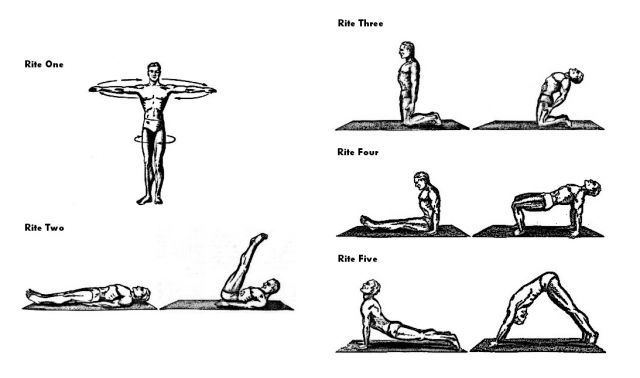
THE 5 TIBETAN RITES OF REJUVENATION: 108 MOVEMENTS TO A MEDITATIVE MIND STATE

By Ethan Indigo Smith

It just so happens that one of the quickest and simplest sets of meditative movements and one of the easiest to integrate as your own, is also one of the most powerful. The Five Tibetan Rites of Rejuvenation take about twenty minutes or so depending on how long you meditate, the longer the better of course.

There are many ways to do the Five Tibetans and the movements will benefit you in multiple ways also. As with all meditative movements, part of the reason people are adverse to beginning it – part of the reason we allow our ego to convince us we do not need to do such practices – is because we see that they take time. But remember meditative movements make time, they give you more energy and more efficiency.

The Five Tibetan Rites of Rejuvenation were not designed as beginner yoga, nor are they, but the fact they only take twenty minutes or so makes them totally accessible to our busied mind and active lifestyle that prevents us beginner yogis from beginning. I have described some finer points of each in the following.

5 Tibetan Rites of Rejuvenation

There are 5 movements done 21 times and 1 movement done, most frequently, 3 times, equating to 108 breath coordinated movements. Each of the Tibetans are followed by taking two breaths so as to balance out the energy just moved. The Sixth Tibetan is only performed after you are capable of doing 21 breath coordinated movements of the Five Tibetans and doesn’t have to be included otherwise. One can begin doing any number of each Rite that you feel comfortable with, but try to do an equal number of each.

The first Tibetan is simply spinning clockwise with the arms active to the sides. The first Rite is done clockwise in unison with the sun for the chakras are said to spin clockwise. When held up such activates and opens up the arms, shoulders and neck. Try going excruciatingly slow. The Five Rites strengthen and activate the abdominal area and neck. These areas are considered the most problematic and clogged in terms of energetic and chakra understandings too. The Rites open up the chakras.
Then take two breaths like Superman, that which devoted practice can turn you into. Hands are at your hips. Take a deep breath through your nose and exhale through your mouth with lips shaped in an O like Superman blowing out cold air.

The trick to the second Tibetan is to lift up and set down the legs and neck in unison. Each Tibetan is done in unison with the breath and as with all meditative movement, the inhale is tension/activation and exhale is relaxation/release. So each movement begins with inhale and returns with exhale. The easiest way to count is to count 1 on the inhale and 1 on the exhale, counting each twice so you are less likely to lose track.

A trick with the third Tibetan is to think about using your hands as support and about bringing bring your back so that it returns to being perpendicular or just slightly past perpendicular, a degree or two forward. Go slow.

The trick to the fourth Tibetan is to initiate the movement with your neck opening the throat chakra.
As you progress you will eventually be able to do the fifth Tibetan with opened joints and ligaments doing Hindi pushups where your face glides along just above the floor and then rises up, like a cobra, on the return/release.

Remember to breathe twice like Superman in between each Rite.

sheet

The 6th Tibetan

The trick with the sixth Tibetan is to not do it unless you can do 21 of each of the first Five. I find three of the sixth Tibetan is optimal and no more than five is advised. For more specifics on the Five Tibetan Rites check out 108 Steps to Be in The Zone
Previous articles by Ethan:
About the author:
Writer Ethan Indigo Smith was born on a farm in Maine and lived in Manhattan for a number of years before migrating west to Mendocino, California. The events of September 11, 2001 inspired him to write his first book, The Complete Patriot’s Guide to Oligarchical Collectivism. He has since written The Matrix of Four, The Philosophy of the Duality of Polarity on the subject of the development of individual consciousness, before expanding into the fiction realm with the controversial The Terraist Letters, a work which humorously contrasts the very serious issues of global nuclear experimentation promotion and global marijuana prohibition. His latest eBooks 108 Steps to Be in The Zone and Tibetan Fusion are available now on Amazon.com
Visit Ethan on Facebook.


Sunday, February 23, 2014

ABORIGINAL MAGIC

by Jani Farrell Roberts. c2000
An extract from her book "Seven Days: Tales of Magic, Sex and Gender."
 
In Australia I have come across many examples of influential Aboriginal female elders being labelled by Christian missionaries as "witches" or, if men, as "witchdoctors". For example, at Philip Creek in Central Australia, the missionaries in the 1970s labelled the traditional female practice of "love magic" or yilpinji as "witchcraft" and called its practitioners "witches". Some Aboriginal men had since used this missionary labelling against women, in order to diminish the power and influence of the women. (Bell p 162) Much the same may have happened in 18th Century England when the "Cunning Folk" who serviced many local communities with magic and were mostly male, disparaged the mostly female practitioners as "witches". (Ref Hutton latest 98)

The Aboriginal women's love magic employed songs and chants centred on the power of one's country or of nature. In these songs, they might use "country" as a metaphor for a loved one. They would sing of their longing for their country, their sorrow at its absence and their anticipation of seeing it again.

Bell wrote: "Yilpinji is achieved through a creative integration of myth, song, gesture and design against a background of country. The circle, the quintessential female symbol, finds expression in the body designs, the rolling hands gesture and patterns traced out by the dancing feet... Ownership of myth and the rights to perform certain rituals provide the power base for the women's claims. ... in yilpinji the women (describe their social world and ) attempt to shape their world." P 173-5 Bell. For example, a woman who wants rid of a husband because he is playing around, may ask her group to perform yilpinji to help make him leave her. Yilpinji, love magic, is invariably based in the empowering link with land possessed by everyone in Aboriginal culture.

Aboriginal women might also attempt to help restore a person to health by gifting them with something that carried their own energy. This could be a gift of blood or body secretions from under the arms or from the eyes. (P161). Some senior healers, known in Central Australia as ngankayi, worked in a different way. They were believed to have special abilities in the removing of foreign bodies from the sick person's body. (which Western medicine might partially agree with - calling these foreign bodies germs or bacteria) Blood from a person causing an injury in a fight might be kept by the victims and later used in a revenge magical attack. Aboriginal people believe that they live in a world full of Ancestral Dreamtime energy and, as part of this world, they have access to this energy.
At Mapoon the missionaries wrote of "Awari (Lizard) or better known as old William, the witch doctor and rainmaker. The other is Namatu (Crocodile) .. Namatu's bearing is dignified ... he takes a leading part in the midnight councils and is held in esteem by all. Under these circumstances it seems strange that although he has been greatly influenced by the preaching of the Gospel... he has never openly confessed Christ." (P51 M.book 2)

The anthropologist Professor Robert Tomkinson, in a marvellous study of the Jigalong Aboriginal community in Western Australia entitled: "The Jigalong Mob: Aboriginal victors of a desert campaign" (1974), told of how Aboriginal people kept their religion intact despite the missionaries trying to suppress it since "the missionaries view the Aborigines as the children of he devil and the antithesis of Christian virtues". Tomkinson's work is very different in kind from that of the first Professor of Anthropology in Australia, A. K. Radcliffe-Brown who was a student of Emile Durkheim. He wrongly reported that in Aboriginal culture the world of the sacred is reserved to men while women had no religion, only "magic." 

Through my work with Aborigines I learnt to much respect the magical way both the women and men worked with nature, drawing on the strength of the earth that cared for them and which they in turn cared for and honoured. Without any drama I had felt I was becoming more and more immersed in this same magic - not by joining in Aboriginal rituals but by simply associating with them, taking part in their fight for land rights and learning to become more and more sensitive to the energies within this vast ancient landscape. It was not my continent by birth right but it was part of the earth that birthed me. I fell in love with her as I got to know her better. My conviction also grew that was that what I was learning from Aborigines was akin to the oldest traditions of my own people of the British Isles.

Aborigines had their own words for healers and magic work. Since they knew the word "witchcraft" from missionaries who translated it into their language as meaning "a worker of harmful and evil magic", those who held fast to the Old Ways might well deny their spiritual work was anything to do with this missionary defined word "witchcraft.". This is also true among other "missionised" indigenous peoples. Many of today's Sami in northern Scandinavia hold the work of their shamans to be sacred and will thus deny it has anything to do with "witchcraft". (The influence of bible translating societies on tribal societies has been documented and deplored by such human rights organisations as Survival International in its book: "Is God an American?")

http://www.witch.plus.com/7day-extracts/Aboriginal-witchcraft.html


Monday, December 9, 2013

VIPASSANA ~ A PATH TO SELF AWARENESS

  October 28, 2013
 vipassana

Vipassana is the way to see things as they really are; it is one of India’s most ancient techniques of meditation that was rediscovered by Gautama Buddha more than 2500 years. He then taught vipassana as a way to enlightenment and a universal remedy for day-to-day problems.

Vipassana saw a resurgence with S N Goenka, who after learning vipassana started teaching others in 1969. This has lead to a whole lot of vipassana institutions cropping up around the world that offer the 10-day course free of cost.

Vipassana is a technique that will eradicate suffering, it is a method of mental purification which allows one to face life’s tensions and problems in a calm, balanced way. The path of Vipassana is not easy and during the course there are many who do not complete it.

The Origin and Spread of Vipassana::

I went through part of this video which shows how Buddha gained enlightenment through Vipassana, how it changed him and how he started teaching people Vipassana to help them get rid of their earthly problems.

The video has nice images for each step of the journey and although the message of Vipassana to enlightenment may be pushed in a little too often.


Doing Time, Doing Vipassana:
 
Doing Time, Doing Vipassana is a full length documentary that talks about how Vipassana was introduced into the Indian prison system and the positive effect it had not only on the prisoners but even improved the interactions between the jail wardens, prisoners and their families. It also includes the story of how Kiran Bedi, the former Inspector General of Prisons in New Delhi, India, strove to transform the notorious Tihar Prison, the largest complex of prisons in South Asia, and turn it into an oasis of peace.
One very interesting part is when a murderer of three people, whose heart is filled with vengeance and is waiting to get out of prison to kill his enemies, undergoes a transformation through Vipassana and ends up filled with compassion. He even calls up the family of the people who he murdered to ask for their forgiveness.


The Dhamma Brothers:

Here’s a documentary film about a group of prison inmates who participate in a 10-day Vipassana retreat at the Donaldson Correctional Facility in Alabama. The film asks “is it possible for these men, some of whom have committed horrendous crimes, to change?”

The Dhamma Brothers tells a dramatic tale of human potential and transformation as it closely follows and documents the stories of the prison inmates as they enter into this arduous and intensive program.


Vipassana Experience:

Here’s one of my friend’s Amit Ayre’s Vipassana experience, “It started off really well. Excited to learn something new on day 1-2. By Day 4, I was done. Felt like I was wasting my holidays because of boredom. By day 5 morning, mind was made up and I was all set to quit. But then something happened. I spoke to the Guruji, who asked me to give it another day. I did. That was the day we started learning the Vipassana technique of meditation. Day 6 onwards, the actual journey started for me.

meditation

It was wonderful after that, I started feeling the vibrations as we progressed. At one point, I felt they were mixing something in my food because of the experience, the vibrations and all that was surreal. Something I could not have imagined possible without psychedelics.

The best part of the day was the discourse where they played a pre-recorded message from S. N. Goenka, it was insane because he had an explanation for whatever was happening with me throughout the day. Everything we did throughout the day and why we did what we did as well as a lot of knowledge about the inner workings of your mind.

On day 10 we started talking and sharing experiences, it was simply wonderful, to add to that, it was also a full moon night. We were done with collecting all the new thoughts and new ideas. I spent that night under the stars, reading up, making notes, questions to ask etc. Another perk was the ability to connect with some incredibly awesome people, it was like Amit 2.0.”

There are hundreds of other Vipassana experiences online and on Youtube. If you are interested in doing a Vipassana course, you can apply for a scheduled course here
 
The Vipassna Course:

People who apply for the course have a strict code of conduct to follow for those ten days. They can’t have any connection with the outside world, all electronic devices are given to the management for this period. They have to maintain silence most of the time, simple vegetarian meals are provided, and neither can one write or read. No physical contact with the same or opposite sex are permitted and perhaps the most important is to declare that you are willing to comply fully with the teachers guidance and instruction during the course.

Apart from that you have to abstain from killing any being, stealing, all sexual activity, telling lies and all intoxicants. If you are a returning student or have done a course earlier then you have three more rules,
abstain from eating after midday, sensual entertainment and bodily decorations and from using high or luxurious beds.


The daily Vipassana course time table is as follows ~
4:00 am
Morning wake-up bell
4:30-6:30 am
Meditate in the hall or in your room
6:30-8:00 am
Breakfast break
8:00-9:00 am
Group meditation in the hall
9:00-11:00 am
Meditate in the hall or in your room according to the teacher’s instructions
11:00-12:00 noon
Lunch break
12noon-1:00 pm
Rest and interviews with the teacher
1:00-2:30 pm
Meditate in the hall or in your room
2:30-3:30 pm
Group meditation in the hall
3:30-5:00 pm
Meditate in the hall or in your own room according to the teacher’s instructions
5:00-6:00 pm
Tea break
6:00-7:00 pm
Group meditation in the hall
7:00-8:15 pm
Teacher’s Discourse in the hall
8:15-9:00 pm
Group meditation in the hall
9:00-9:30 pm
Question time in the hall
9:30 pm
Retire to your own room–Lights out
 
Resources:

Dhamma Vipassana Image


http://fractalenlightenment.com/15406/spirituality/vipassana-a-path-to-self-awareness


Wednesday, December 4, 2013

THUGINE, THE RAINBOW AND THE WANDERING BOYS

Far to the west in the deep blue sea there dwells a great serpent named Thugine. His scales are of many shimmering colors. When a rainbow appears in the sky, it is Thugine curving his back and the sun reflecting the colors of his scales.

Many years ago, a tribe of blacks camped close to a sea beach. One morning they all went out to fish and hunt, with the exception of two boys, whom the old men left in charge of the camp. Wander not into the forest lest the wild dogs eat you, or to the beach, where Thugine the serpent is -waiting for children who wander alone." This was the parting advice of the old men to the boys.

When the men had departed, the boys played about the camp for a while, but they soon grew tired of their games. The day was very hot, and in the distance the boys could hear the dull, deep booming of the surf. Both the boys were longing to go to the beach, but were afraid to speak their desire. At last the elder boy spoke, and said: "The fires of the sun are burning bright to-day, but on the breeze I can feel the cool breath of the sea. Let us go to the beach, and we shall return before the shadow of night has fallen. The men will not know." The other boy hesitated and was afraid, but at last he yielded, and together they wandered hand in hand through the bush.

After walking for some time they came to an opening in the trees, and, before their expectant gaze, a wonderful scene unfolded. A golden beach stretched far away until it was lost to view in the dim distance. The cool waves rolled lazily in great green billows from the outer reef, and dashed in a haze of sparkling white foam on the hot sands of the palm-fringed beach. The song of the sea rose in a deep, loud booming, and gradually died away to a low, soft murmuring. The boys were lost in wonder at the beauty of the scene. Never had they seen such an expanse of water sparkling in the sun like the blue sky. Over its rippled surface the shadows ,of the clouds floated like sails across the sun.

Thugine, the serpent, had seen the boys coming from afar, and, while they played on the beach, he swam swiftly and silently to the shore and seized them. When the men arrived at the camp, they discovered the absence of the boys. They searched the bush all through the -night, and at dawn came to the beach. Far from the shore they saw two, black rocks jutting out of the sea. Then they knew that Thugine had taken the wandering boys and turned them into rocks. The men turned their faces again towards the camp; their hearts were heavy and their thoughts were sad.

To this day the rocks remain between Double Island Point and Inship Point, When a rainbow appears in the sky, the old men of the tribe tell the story of the disobedience and punishment of the wandering boys.

http://www.sacred-texts.com/aus/mla/mla17.htm


Sunday, December 1, 2013

HOW THE SUN WAS MADE DAWN, NOONTIDE AND NIGHT

When the emu egg was hurled up to the sky it struck a great pile of wood which had been gathered by a cloud man named Ngoudenout. It hit the wood with such force that the pile instantly burst into flame, and flooded the earth with the soft, warm light of dawn. The flowers were so surprised that they lifted their sleepy heads to the sky, and opened their petals so wide that the glistening dewdrops which night had given them fell to the ground and were lost.

The little birds twittered excitedly on the trees, and the fairies, who kept the snow on the mountain tops, forgot their task, and allowed it to thaw and run into the rivers and creeks. And what was the cause of this excitement?

Away to the east, far over the mountains, the purple shadows of night were turning grey; the soft, pink-tinted clouds floated slowly across the sky like red-breasted birds winging their way to a far land. Along the dim sky-line a path of golden fire marked the parting of the grey shadows, and down in the valley the white mist was hiding the pale face of night.

Like a sleeper stirring softly at the warm touch of a kiss, all living things of the bush stirred at the caress of dawn. The sun rose with golden splendor in a clear blue sky, and, with its coming, the first day dawned. At first the wood pile burned slowly, but the heat increased, until at noonday it was thoroughly ablaze. But gradually it burnt lower and lower, until at twilight only a heap of glowing embers remained. These embers slowly turned cold and grey. The purple shadows and white mists came from their hiding-places, and once again the mantle of night was over the land.
When Ngoudenout saw what a splendid thing the sun was, he determined to give it to us for ever. At night, when the fire of the sun has burnt out, he goes to a dark forest in the sky and collects a great pile, of wood. At dawn he lights it, and it burns feebly until noonday is reached, then it slowly burns away until twilight and night falls. Ngoudenout, the eternal wood gatherer, then makes his lonely way to the forest for the wood that lights the fire of the sun.

http://www.sacred-texts.com/aus/mla/mla16.htm


WHY THE EMU HAS SHORT WINGS AND THE NATIVE COMPANION A HARSH VOICE

An emu with very long wings once made her home in the sky. One day she looked over the edge of the clouds, and down on the earth she saw a great gathering of birds dancing by a reed-grown lagoon. High in a gumtree the bell birds were making sweet music with their silvery chimes; the kookaburra, perched on the limb of a dead tree, was chuckling pleasantly to himself; while the native companion danced gracefully on the grass nearby.

The emu was very interested in dancing, so she flew down from her home beyond the clouds, and asked the birds if they would teach her to dance. A cunning old native companion replied: "We shall be very pleased to teach you our dances, but you could never learn with such long wings. If you like, we will clip them for you." The emu did not give much thought to the fact that short wings would never carry her home again. So great was her vanity that she allowed her wings to be clipped very short. When she had done so, the native companions immediately spread their long wings-which they had previously concealed by folding them close against their backs-and flew away, leaving the emu lonely and wiser than before. She never returned to her home in the sky, because her wings would not grow again. They have remained short and useless ever since. This is the reason why emus run very fast, but never fly.

After wandering alone for a long time the emu reconciled herself to a home on the earth, and reared a large family. One day she was walking through the bush when the native companion-who also had a large family-saw her in the distance. The native companion immediately hid all her chicks in the undergrowth, except one; then she approached the emu in a friendly manner, and said: "What a very weary life you must have feeding such a large family. You are looking very ill, and I am sure you will die. I have only one chick. Take my advice and kill your chicks before they kill you." The foolish emu again listened to the soft words of the other bird, and destroyed all her chicks.

Thereupon the native companion called in a low, sweet voice, "Geralka Beralka, Geralka Beralka," and all her fluffy little chicks came running to her from the bushes in which she had hidden them. The emu was frantic with grief when she realised what she had done; but once again she paid the price of vanity and idle flattery with a sad and lonely heart. The native companion was so eager to call her chicks after the cruel trick she had played on the emu that she twisted her neck, and lost her beautiful voice for ever. And now she can call with only two harsh, discordant sounds.

The seasons passed, and once again the emu had a big clutch of eggs. One day the native companion paid her a visit and pretended to be friendly, but the sight of her old enemy made the emu very angry. The emu made a savage rush at her, but the native companion hopped over her back and broke all the eggs except one. After dancing around for a little while, the native companion made a determined rush, and, seizing the remaining egg, threw it up into the sky.

http://www.sacred-texts.com/aus/mla/mla15.htm


HOW THE KANGAROO GOT A LONG TAIL, AND THE WOMBAT A FLAT FOREHEAD

Many years ago, Mirram the kangaroo and Warreen the wombat were both men. They were very friendly, and hunted and lived together in the same camping-ground. Warreen had a very comfortable gunyah made of bark and soft leaves, but Mirram who was a careless fellow-did not trouble to build a home. He was content to sleep in the open, by the side of a big fire, with the blue sky for a cover, and the green grass for a couch. This open air life was very nice in fine weather, when the stars twinkled in the sky like golden fire-flies, but it was extremely uncomfortable in the rainy season.

Ore night a great storm arose. The wind howled eerily, and rocked the tall trees to and fro as though they were shaken by the strong arms of an invisible giant. The rain fell in torrents, and darkness covered the light of the stars. The rain quickly quenched the glowing embers of Mirram's fire, and he was left to the mercy of the storm. After shivering in the cold for some time, he decided to seek the hospitality of Warreen. "Surely my friend would not refuse me shelter on such a night as this," he thought. "I will ask him."

Feeling very cold and miserable, he crept to the opening of Warreen's tent, and seeing there was sufficient space for both of them to sleep comfortably, he woke him and said: "The storm has killed my fire. I am very wet, and the cold wind has chilled me to the bone. May I sleep in the corner of your tent?" Warreen blinked his eyes sleepily and answered in a gruff voice: "No. I want to place my head in that corner. There isn't any room." With this rude remark he moved into the corner, but, as he could not occupy the whole space of the tent, another corner became vacant. Mirram went away and sat by the wet ashes of his fire, and his thoughts were as miserable as the weather. The fury of the storm increased, and looking anxiously at the rainproof gunyah of his friend, he decided to approach Warreen again. He entered the shelter, and, touching Warreen gently on the shoulder, said: "The wind is very cold, and as biting as the teeth of the wild dog. The rain is falling heavily and will not cease. I should be grateful if you would allow me to sleep in that corner. I will not disturb you." Warreen raised his head, listened to the moaning of the storm outside, and then replied: "I will not have you here; there isn't any room. Go outside and do not keep waking me." "But," replied Mirram, "there is room in that corner. Surely you wouldn't drive me out into the storm to die!"

Thereupon, Warreen moved one leg into the corner and again a space became vacant. Seeing he could no longer hoodwink Mirram and hide from him his selfish intentions, he grew very angry and yelled: "Get out! Get out! I won't have you in my tent. I don't care where you die." This harsh treatment exasperated Mirram and he left the tent in a terrible rage. Outside the tent, he groped around in the dark until he found a large flat stone. Then he crept silently to the gunyah. By the sound of heavy breathing he knew Warreen was asleep. Moving very silently, he entered the tent, and, raising the stone high in his arms, dashed it on the head of the sleeper. The terrible blow did not kill Warreen but flattened his forehead. When he had recovered from his pained surprise, he heard the mocking voice of Mirram saying: "That is your reward for treating a friend so cruelly. You and your children and their children's children will wander through the land with flat foreheads that men may know them for your selfishness." As Warreen was no match for his opponent, he did not answer, but nursed his sore head and some very bad thoughts. From that moment, he was always planning revenge for his injury.

Some time later, Warreen was hunting in the forest, and, through the shadow of the trees, he saw Mirram a short distance ahead. He crept noiselessly towards him, and, when Mirram was looking for the marks of a possum on the bark of a tree, he threw a spear at him with all his strength. The spear struck Mirram at the bottom of the back, and so deeply did it enter that he could not pull it out. While he was struggling with the spear, Warreen walked up to him, and, in a bantering voice, said: "Aha! My turn has come at last. I have waited long to repay you. You will always carry the spear in your back and wander without a home while you live. Your children will carry the spear and be homeless for ever. By these tokens, men will always remember your attempt to kill me while I slept."

From that time the kangaroo has had a long tail, which makes a low, thudding sound as he wanders homeless through the bush, and the wombat still has a very flat forehead as an everlasting sign of selfishness.

http://www.sacred-texts.com/aus/mla/mla14.htm